India's outstanding performance in United Nations Sustainable Development Goal Index
1. What is news?
India has secured position among top 100 countries in the United Nations Sustainable Development Goal Index. It is significant as India has achieved this feat first time since the release of index.
2. About Sustainable Development Goal Index
1) Since 2016 the index is being published by United Nations Sustainable Development Solutions Network (SDSN).
2) SDSN operates under United Nations secretary-general to drive action on Sustainable Development Goals and Paris Climate Change Agreement.
3) SDSN established in 2012 by then UN Secretary-General Ban ki Moon and renowned economist Jeffrey Sachs.
4) Sustainable Development report includes both Sustainable Development Goal (SDG) index and Dashboards.
5) This report provides performance of all 193 UN (United Nations) member states on the 17 SDG’s.
3. India's performance in 2025 SGD Index
1) India ranked 99th out of 167 nations in 2025 edition of the Sustainable Development Report.
2) India scored 67 this year. Also, it is big jump from 109th rank in 2024 to 99th rank in 2025.
3) Among India’s neighbours, Bhutan and Nepal ranked ahead of India whereas Bangladesh and Pakistan (140th) ranked below India.
4) Finland, Sweden and Denmark hold the top 3 positions.
4. History of Sustainable Development
1) In 1983 the Brundtland Commission was established, formally knowns as World Commission on Environment and Development (WCED).
2) Definition of Sustainable Development: In 1987 Brundtland Report titled ‘Our Common Future’ introduced the definition of Sustainable Development.
3) The definition: “Development that meets the needs of present generations without compromising the needs of future generations”
4) Rio Earth Summit: In 1992, United Nations Conference on Environment and Development held in Rio de Janeiro, Brazil.
5) In this summit, Agenda 21 – comprehensive plan for sustainable development and Rio Declaration – 27 principles guiding sustainable development were introduced.
6) Rio + 20 Summit: To commemorate 20th anniversary of Rio Earth Summit. It is called United Nations Conference of Sustainable Development. It paved the way for the replacement of Millennium Development Goals.
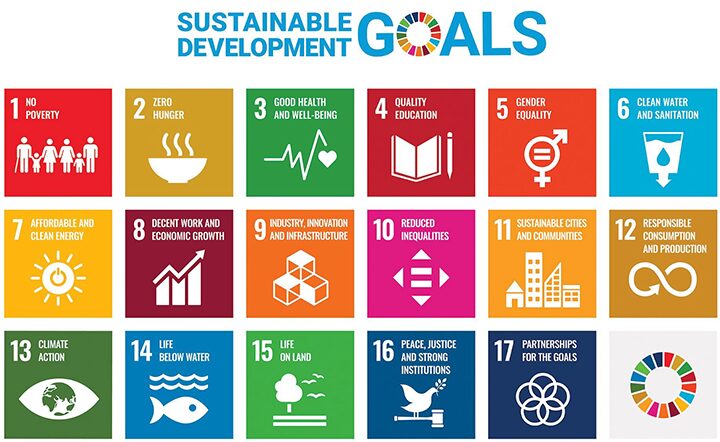
7) Adoption of Sustainable Development Goals: In 2015, at UN General Assembly at New York, 193 countries adopted 2030 agenda for sustainable development which includes 17 SDGs and 169 targets to be achieved by 2030.
5. 17 Sustainable Development Goals
6. NITI Aayog's SDG India Index
1) NITI Aayog is releasing SDG India Index since 2018.
2) This index monitors progress of 16 Sustainable Development Goals for each state and Union Territory.
3) Overall State and UT (Union Territory) scores are generated besides composite scores which is cumulative score for both State and UTs.
4) Scores are divided into 4 categories:
i) Aspirant (0-49)
ii) Performer (50-64)
iii) Front Runner (65-99)
iv) Achiever (100)
7. SDG India 2023-24 Report (Latest)
1) Overall SDG score for the country is 71 for 2023-24, significant improvement from 66 in 2020-21 and 57 in 2018.
2) Significant progress in Goals 1 (No Poverty), 8 (Decent Work and Economic Growth), 13 (Climate Action) and 15 (Life on Land).
3) There are 32 States and UTs in Front Runner Category (65-99 score).
4) SDG India Index 2023-24 is the fourth edition of the index.
8. India's progress
1) Multidimensional poverty nearly halved from 24.8% to 14.96% between 2015-16 and 2019-21.
2) 99.7% were offered employment of the persons demanding employment under MGNREGA in 2023–2024.
3) 41% of households have at least one member covered under health insurance or health scheme as per NFHS-5 (2019-21), an improvement from 28.7% in NFHS -4 (2015-16).
4) 99.01% of beneficiaries covered under National Food Security Act (NFSA), 2013.
5) Maternal Mortality Rate per 1,00,000 live births stand at 97. Reduced under 5 mortality rate (per 1,000 live births) from 36 in 2016-18 to 32 in 2018-20.
6) 100% parity between females and males in Higher Education (18-23 years). Pupil Teacher Ratio is 18 for 2021-22, thus achieving the target of 30.
7) Improved ratio of female to male Labour Force Participation Rate (LFPR) (15-59 years) from 0.33 in 2018-19 to 0.48 in 2022-23.
8) All individual household toilets have been constructed against target and all districts have verified to be ODF under SBM(G).
9) 100% households have access to electricity under Saubhagya Scheme.
10) Reduction in unemployment rate (15-59 years) from 6.2% in 2018-19 to 3.40% in 2022-23.
11) Improvement in electricity generation from renewable energy from 36.37% in 2020 to 43.28% in 2024.
12) Nearly 25% geographical area under forests and tree cover – as per India State of Forest Report 2021.